



- Details
Please see the updated SKGB Refereeing section in this website, with new resources on the following topics:
Please see the updated SKGB Refereeing section in this website, with new resources on the following topics:
Scotland becomes first country in the world to introduce menstrual break policy in karate competition Scotland has become the first country in the world to introduce a formal menstrual break policy in karate competition, in a move expected to influence governing bodies across world sport.
The Scottish Karate Governing Body (SKGB) has approved a new rule allowing athletes, officials and coaches who menstruate to request dedicated menstrual-related breaks during competition. The policy, which came into force in November, provides competitors with up to 10 minutes to change their karate gi if menstrual blood becomes visible during or between bouts.
Under previous World Karate Federation (WKF) regulations, athletes were typically given two minutes to change a blood-stained gi – a rule designed for injuries rather than menstruation. The new Scottish policy formally recognises that menstrual bleeding is not comparable to an injury and may require more time to manage safely and with dignity. The policy was developed by Dr Chloe Maclean, Director of Women and Girls’ Interests at Karate Scotland and Lecturer in Sociology at the University of the West of Scotland. Menstruating officials and coaches will also be entitled to breaks, with regular 3–4 hour rotations recommended to reduce the likelihood of emergency requests.
Dr Maclean said:
“Menstruation affects a significant proportion of athletes, yet most sports policies still treat menstrual bleeding as either invisible or as a disciplinary issue when it becomes visible. “We believe this is the first policy globally to explicitly recognise menstruation within competition rules and to make practical provision for it. Our aim is to support full participation and remove the stigma that still surrounds menstrual health in sport.”
It is hoped that this new policy will attract interest from other sports where white or light-coloured kits are standard, including tennis, cricket and athletics.
In recent years, several female tennis players have publicly voiced concerns over wearing white during menstruation, yet no comparable competition-level policy currently exists in global tennis or other major sports. In 2023, female players at Wimbledon were able to wear coloured shorts and underwear for the first time and at the Women’s World Cup in the same year, several national teams, including England, switched their traditional white shorts for darker options. While these changes have been widely welcomed, they are still only optional with some legal experts arguing that genuine accommodation of menstruation is not just good practice but a requirement under the Equality Act 2010.
Paul Giannandrea, Chair of Karate Scotland, said:
“As a governing body we have a responsibility to ensure our sport is inclusive and responsive to the realities faced by athletes. “This world-first policy shows Scotland is leading the way in recognising menstrual health as a core part of athlete welfare. We hope it encourages other sports to follow suit.”
The SKGB will apply the policy across all authorised competitions in Scotland, including kumite and kata events. It is hoped that this change will not only normalise discussion of menstrual health but also ensure athletes are not penalised or embarrassed during high-pressure competitions.
Notes: Karate Scotland issued the “Periods and Karate” report by Dr Chloe Maclean who also completed research into the impact of periods on women and girls in karate, the key findings of which were that:
• 72% of respondents have missed a karate class due to their period, with 16% missing karate classes almost every period;
• 64% felt that their enjoyment of karate slightly worsens when on their period and 15% felt that it significantly worsens;
• a key factor impacting attendance and enjoyment was worries about leaking blood onto the karate suit – 95% of respondents worried about this, with 43% worrying about leaking at every class;
• 61% had experienced leaking blood onto their clothing at karate; and
• 2% felt supported when they had leaked blood.
“The experience left women feeling embarrassed, and worried that others in the karate classes – particularly men/ boys – might feel uncomfortable or disgusted.”
About Karate Scotland
The Scottish Karate Governing Body is the national governing body for karate in Scotland and is responsible for overseeing competition, regulation, athlete welfare and development.
About University of the West of Scotland
University of the West of Scotland has been named The Times and The Sunday Times Scottish University of the Year for Social Inclusion 2026 and is one of Scotland’s largest modern universities. Our reach across the south and west of Scotland, together with our London campus, means that UWS is a significant force in global knowledge creation, innovation, and a leading provider of undergraduate, postgraduate and research degree education. Our degrees provide students with a transformational experience, resulting in highly sought-after graduates in world-leading sectors, industries and businesses. UWS’s employer-focused degrees align with business, community, third sector, government and international priorities, and provide the perfect springboard to create economic benefits across Scotland, the UK and beyond. With cutting-edge courses, modern pedagogy and practical knowledge, we enable our students and staff to experience the joy of learning, teaching, research and innovation, and apply their knowledge for the benefit of others.
 EKF U21 EKF U21 | 156 kB |
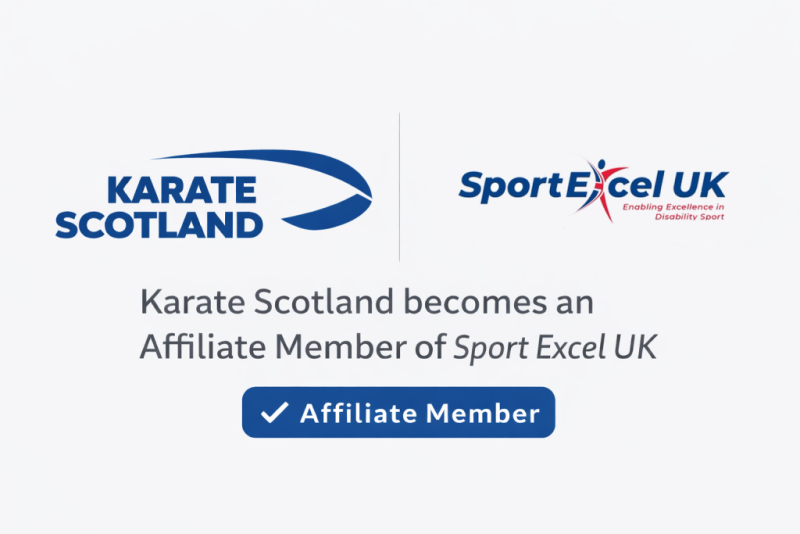
Sport Excel UK is pleased to announce a new strategic partnership with Karate Scotland, who have become the first National Governing Body in karate to sign up as an Affiliate Member of Sport Excel UK.
Please see their website - https://sportexceluk.org
The agreement marks an important milestone for both organisations and represents a bold step forward in strengthening, connecting, and championing the pathway for athletes with intellectual impairment across the UK.
The new Affiliate Member programme, formally launched this autumn is designed to bring National Governing Bodies (NGBs) into closer alignment with Sport Excel UK, supporting shared values around collaboration, inclusion, athlete voice, and excellence at every level of the pathway.
Karate Scotland’s leadership in becoming the first karate organisation to formalise this status places them firmly at the forefront of progress, demonstrating both ambition and commitment to developing meaningful opportunities for Scottish athletes with intellectual impairment at grassroots, national, and international level.
Through the Memorandum of Understanding, the partnership will enable:
This is the first in a series of new affiliate partnerships Sport Excel UK will be announcing, as part of a wider strategy to build a stronger, more connected, and more visible system for athletes with intellectual impairment.
Tracey McCillen, Chief Executive, Sport Excel UK, said:
“We are delighted to welcome Karate Scotland as our first Karate Affiliate Member. This partnership reflects everything Sport Excel UK stands for, collaboration, shared values, and strengthening the pathway so that athletes with intellectual impairment are supported, recognised, and able to excel.
Karate Scotland’s commitment to leading from the front sends a powerful message across the sector, and we are excited to work side-by-side to develop opportunities that truly make a difference. We are thrilled to end 2025 on a high.”
Paul Giannandrea, Chairman, Karate Scotland, said:
‘Karate Scotland and Sport Excel UK are proud and excited to formally confirm an Affiliate Partnership, effective immediately. This strategic affiliation unites two organizations dedicated to excellence, performance, and the promotion of a dynamic and active lifestyle within the sporting community.
This partnership is built on shared values of integrity, innovation, and a commitment to delivering world-class resources and opportunities to our impaired athletes.’
Gavin MacLeod, Chief Executive, Scottish Disability Sport, said:
‘Scottish Disability Sport would like to congratulate Sport Excel UK and Scottish Karate on the establishment of this innovative memorandum of understanding.
This partnership will support the development of athletes with intellectual impairment in Scotland and open up access to competition opportunities at a national and international level. It will also act as an example of best practice that will hopefully inspire other sports organisations to seriously consider the needs of athletes and players with disabilities. Congratulations to both organisations once again.’
The affiliate programme is open to National Governing Bodies of Sport, Sports Organisations and other bodies who wish to demonstrate a commitment to inclusion and enabling athletes with intellectual disability, down syndrome and autism to excel.
For more information contact Sport Excel UK or Karate Scotland
_________________________________________
About Sport Excel UK
Sport Excel UK is the national charity responsible for promoting, supporting, and enabling talented athletes with intellectual impairment across the UK. Sport Excel UK manages the eligibility and classification system, are recognised by UK Sport, are a member of Paralympics GB, and are the official Great Britain member of Virtus. Intellectual impairment is a term that includes athletes with intellectual disability (class II1), down syndrome (class II2) and autism (class II3), all three of whom are recognised classes in Sport Excel UK, Virtus and now Karate Scotland pathways.
About Karate Scotland
Karate Scotland is the Scottish Governing Body for karate, committed to promoting participation, developing performance, and strengthening pathways for athletes across Scotland at every level of the sport.
About Scottish Disability Sport
Scottish Disability Sport (SDS) is the Scottish governing body for participants and athletes with physical, sensory and learning disabilities of all ages.
About Intellectual Impairment
Intellectual Impairment is the term used by Sport Excel UK and others in sport and includes intellectual disability, down syndrome and autism.
Other terms used include, learning disability which is used in the UK, with intellectual disability and intellectual impairment being used internationally in sport. Learning disability/intellectual disability is an “invisible disability”. It inhibits how a person learns and performs everyday functions that others take for granted. It also reduces communication, understanding, social, and living skills. In elite performance sport learning disability is defined as an IQ of 75 or less; significant limitations in adaptive behaviour and age of onset of the learning disability being in the development years, i.e. 0 -22 years. This definition adopted by Virtus is from the World Health Organisation (WHO) definition of learning disability (mental handicap) and is in line with other internationally recognised definitions.
Different criteria exist for Virtus class II2 (Additional Significant Impairment, including Down syndrome) and class II3 (Autism) which requires a formal diagnosis of autism. Criteria for all three classes have been set by Virtus. More information is available under ‘classification’ .
Karate Scotland National Squad CV Application Form - Kata & Kumite.
Relevant events are All British/Scottish National & International events International Opens & All WKF classed events.
PLEASE REMEMBER REGULAR ATTENDANCE AT NATIONAL SQUAD TRAINING SESSIONS WILL BE TAKEN INTO ACCOUNT.
CV's will only be accepted on this format.
  new-national-squad-CV-form.xlsx new-national-squad-CV-form.xlsx | 0.1 kB |
The Sports Management Team are looking to add to additional Kumite and Kata coaches to the Team.
Job descriptions attached.
Closing dates for applications close on business on the 5th December
Happy International Women's Day!
Karate Scotland board of directors would like to wish our members a happy International Women's Day.
Congratulations and thank you to every woman and girl who has started karate this year, continued to improve their karate, dedicated their time to coaching in communities across Scotland, gained qualifications as coaches or officials, or taken part in competitions at home and abroad.
Some of many highlights include:
• Elize Bauld - World junior silver medalist!
• Mia Ewing - European cadet bronze medalist!
• Amy Connell continues to develop the WKF Guardian Girls programme.
We have a wealth of talented women and girls in Scottish karate who continue to inspire women, men, girls and boys alike - thank you!
Best wishes, Chloe Maclean Director of women and girls’ interests
 Adam Hamill European champion.
 Benjamin Packwood European champion.
 Maia Ewing European Bronze Medal
Supported by